Let’s get this bread

So, this will be my final blog post (for now?). What a journey it has been. As most followers of this blog will know, whether it be fellow classmates, my friends or even the odd random reader, this blog was created as part of an assignment for a 3rd-year digital marketing unit.

As clichéd as it sounds, it’s been a lot more than just an assessment piece. This blog has been great period of learning for me and I hope you got something out of it as well. I want to share some final thoughts on digital marketing with you before we disembark.

Source: Giphy

The world of digital marketing is moving incredibly fast. Not only is it especially pertinent to businesses so they remain afloat and on top, but I’ve realised as a consumer myself, how important it is to be aware of the changes in digital marketing and how they are affecting me.

I think some really exciting developments have the increased use of augmented reality and artificial intelligence being used in digital marketing and how this will only continue to grow. Smart Mirrors which I spoke about in a previous blog are only the beginning for AR being incorporated into the customer experience.

It will be exciting as well to see the growth of customer assistance tools such as the chat bot and voice search. These services are only going to increase in quality and with that, I think the prevalence of them in our lives will continue to surge.

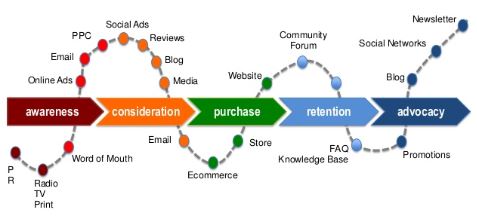
There have also been more topics that I’ve wanted to talk to you about but haven’t been able to fit in. This includes the topic of the digital customer journey and how there are SO many touchpoints that we as consumers are affected by in the process of buying a product or using a service.
Source: Slideshare

Another topic is the censorship of posts surrounding the Hong Kong protest on the popularly used and Chinese-owned app TiK Tok. Unlike other social media apps such as Facebook, Twitter and Instagram, there is plenty of content being posted and shared about the Hong Kong protests.

Source: Futurism

However with the same protest being censored by Tik Tok, the question must be asked; is this stifling freedom of speech and the global spread of information? Should social media companies be able to control the flow of information based on political alignment?

Thanks again for following, I’ll see you soon.

Is AR the direction for retailers?

Augmented Reality (AR) is using technology to overlay digital imaging onto a user’s view of the real world.

I came across my first major experience with AR when I visited the Digital Art museum by teamLab in Tokyo earlier this year. The exhibition was a maze of fascinating displays of digital art. It definitely exposed me to the excitement and marketability encompassing AR. teamLab are in Melbourne right now, so check them out here.

A few photos I took at the Digital Art Museum

So how can AR bring value to retailers, especially clothing stores?

One method that is emerging is the ‘Smart Mirror’. This is a form of AR technology that allows consumers to try on clothing, make-up, jewellery and even eye wear, virtually. The aim of these mirrors would be to encourage online shoppers back into the stores by creating excitement and functionality with the technology.

It is well known that the online shopping is increasing, with research estimating that by 2025, at least of 35% of shopping will be online. Due to this, retailers are beginning to sublet or exit their existing unprofitable stores and move to smaller-footprint stores. With less room to showcase clothing on the floor, smart mirrors would be an economical method to display options to customers whilst still saving space.

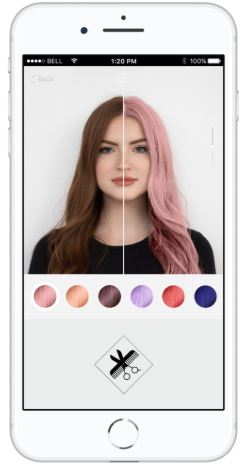
L’Oreal has also launched an app called ‘Style My Hair’ that adopts similar principles to Smart Mirrors. The app allows users to change their hair colour digitally using live video, allowing them the ‘try before you buy’ experience.

Allowing users to trial the product and make a decision before they enter the store can be beneficial. In 2018, Australia retailers experienced $12.52bn AUD total losses due to customers prematurely leaving due to long lines. Customers knowing what they want beforehand could create less congestion in stores.

Do you think AR technology such as Smart Mirrors would be beneficial to retailers in Australia?

How private can data be?

In its nature, digital marketing involves the collection, use and dissemination of personal information.

Data privacy concerns are on the rise. Cambridge Analytica harvesting the private information of Facebook users received huge backlash. The push for the re-launch of the My Health Record in Australia raised concerns about data breaches. This has meant that there is focused attention on regulators and law makers making decisions on big data, ad technology and direct marketing.

Source: CNBC

There are a few issues to look at here.

The first is the security threats to digital marketing. The My Health Record can be used as an example – where there was concern that a database filled with consumer’s personal information had the potential to be hacked. According to the PWC, in the past two years, 45% of Australian companies were attacked by online criminals.

Data being held by marketers is a treasure chest for hackers to pry into and take advantage of. As a result, digital marketers must be aware of the security threats to not only their consumers but themselves. Failure to do so could lead to legal and financial sanctions as well as terrible publicity.

The second issue is with organisations and marketers themselves. How lawful and trustworthy are they in attaining and then using personal data?

The Privacy Act 1988 was introduced to protect the privacy and personal information of individuals. In addition, it ensures that Australian Government agencies and organisations with an annual turnover rate of more than $3 million are regulated.

Source: Gotocourt

The Privacy Act makes it clear that marketers shouldn’t be collecting personal information unless it is absolutely necessary for business functions. There are also stricter rules on cross border disclosure of personal information – so businesses need to ensure that overseas recipients are not breaching the Australian Privacy Principles.

With smart products increasing in scale, marketers and organisations have greater ease in collecting data.

Source: Emarketer

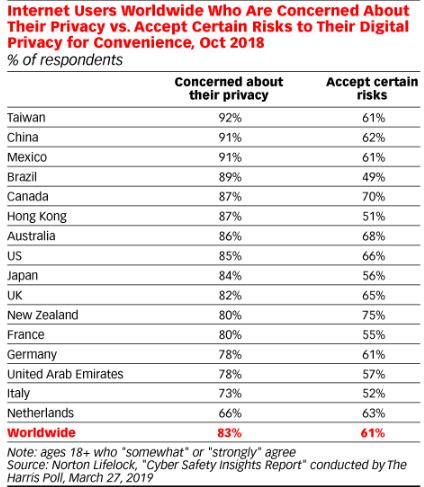
This table demonstrates that on average 83% of people worldwide have concerns about their privacy. However, there is still a large proportion that are accepting risks, whether that be not reading privacy policies before they sign up to an app. So does this mean people are just accepting the inevitable that we have entered a time period where it’s going to be impossible to completely protect your privacy?

What do you think about these issues of data privacy?

Unpacking digital distraction

The ‘always-on’ digital age has increased the time we spend looking at screens and staying online.

This has resulted in concerns about productivity, creativity, social cohesion as well as mental and physical health. In the battle to reclaim productivity and creativity, businesses and individuals are taking proactive steps to fix it.

The New York Times ran a piece on parents hiring coaches to transition their children off gaming, smartphones and laptops. Gloria DeGaetano, a private coach in Seattle launched her coaching organisation, noticing there was a demand for parents needing assistance to adjust their children’s screen behaviour. Her institution will charge $80 an hour in rural cities with larger cities rates charging up to $250 an hour.

Digital distraction extends to businesses and employers. Phones, constant emailing and even cloud-based workplace productivity systems like Slack can exacerbate distraction problems in the workplace. In his article ‘Work Distractions – The Productivity Thief’, Charles H. Wilson advises management to set the expectation for personal use of computers and phones during company times.

So as the dialogue and action to limit the amount of our screen time emerges; how does this affect digital marketers in their attempt to capture our attention?

Source: Giphy

Well we know that time spent on mobiles is continually increasing. This year was the first time that people spent more time on their mobile than watching TV. That’s on average, three hours and 43 minutes of watching content, checking social media and viewing ads on phones.

With this shift comes an adapted strategy from marketers to optimise their mobile content. The traditional method of using above-the-line marketing and then using similar versions of content for the rest of marketing collateral isn’t viable anymore. The savviest marketers are creating ‘mobile-first’ ads that are relevant to the the platform they’re being shared on. Ads are bite-sized, relatable and actionable to get the attention of time-poor consumers.

Check out this bumper ad for the film ‘Sing’.

Source: Youtube

What do you think about reducing screen time; have you found yourself being negatively impacted by too much screen?

How else will reducing screen time affect digital marketing?

Let’s chat (bot)

Guess what we’re delving into today. You guessed it. Chatbots!

Source: Medium

I’m sure you’ve encountered these bad bo(t)s before, but let’s give a quick run through of what they are. Chatbots are an AI-powered software that facilitates conversations with customers online. They use a process known as deep learning, whereby the network identifies specific patterns, speech and data. After, it transmits the data through layers of network to ensure accurate results every time the AI encounters the same query from a consumer.

Why are they a positive transformation for digital marketing?

Chatbots streamline and manage the initial marketing process for businesses. They engage humans by answering to queries, recording contact details and providing direction on tech issues. They do this so businesses can spend time working on other things and when human interaction is required, there’s already a profile of the customer allowing a personalised approach which can have a huge positive impact for the business.

Source: manychat

The Duolingo Bot is an example of a chat bot done well. They recognised that a pain point for their customers was practising speech with native speakers. It can not only be awkward, but embarrassing. So their AI-powered chat bot app ensures a comfortable environment for users to chat and develop their language skills.

So what do I think of chat bots? I’ve encountered a few chat bots in my time. I’m pretty old-school, so finding myself talking to a bot feels weird and I’m also hesitant. I much prefer talking to a human. However, in saying that, I have found myself more comfortable talking to chat bots the more I encounter them. I also prefer bots to calling someone up for an answer or emailing a company. Chat bots are convenient and they give you the answers you want quick. So although I have found them a bit strange, I recognise their practicality.

Have you found yourself chatting to a bot lately? Fill me in with your stories.

FAKE NEWS

You may have heard of the term ‘fake news’ circulating around. Like many other expressions and events, it also has been memefied.

However, the effect of fake news on digital marketing is to be taken seriously.

Websites that share misinformation often place trustworthy advertisements on their page to appear legitimate. This occurs due to large brands advertising through automated platforms. By this happening, brands can lose control of the placement of their ads, creating undesired association between the fraudulent content and the brand’s image and values.

Does the placement of the brand on the internet actually affect the perception of the viewer?

Source: Giphy

The author’s of this article conducted an experiment testing the influence that ‘fake news’ had on a brand. Participants were shown two web pages; one with the logo of a reputable news source and one known for its click-bait. Each web page had accompanying articles as well as ads from well-known car brands. It was hoped that the reputation of these cars would override the effect of fake news.

The experiment found that the the factual story posted had no real effect on the viewer’s perception of the brand’s advertisement. The fake news did. Whether it was posted on a reputable or non-reputable website, the low credibility of the article transferred across to viewer’s perception of the brand, affecting it negatively. People were less likely to speak positively about the brand or purchase its products.

With more people receiving their news from social media such as Facebook, brands need to be careful about where their ads are being placed.

Brands also need to be better understand the red flags consumers are looking for to determine whether or not they trust the content they are seeing on social media or on a website.

How do you know if you’re reading fake news? Let me know in the comments below!

PART 2: Voice Search SEO

Let’s kick on from last week’s topic of Search SEO and move from the keyboard to the microphone.

Here’s what we know about Voice Search right now

Voice Search (VS) uses voice recognition tech allowing users to perform searches by speaking into a device. Most searches come from mobile devices, but we’re seeing a rising popularity in home assistant devices.

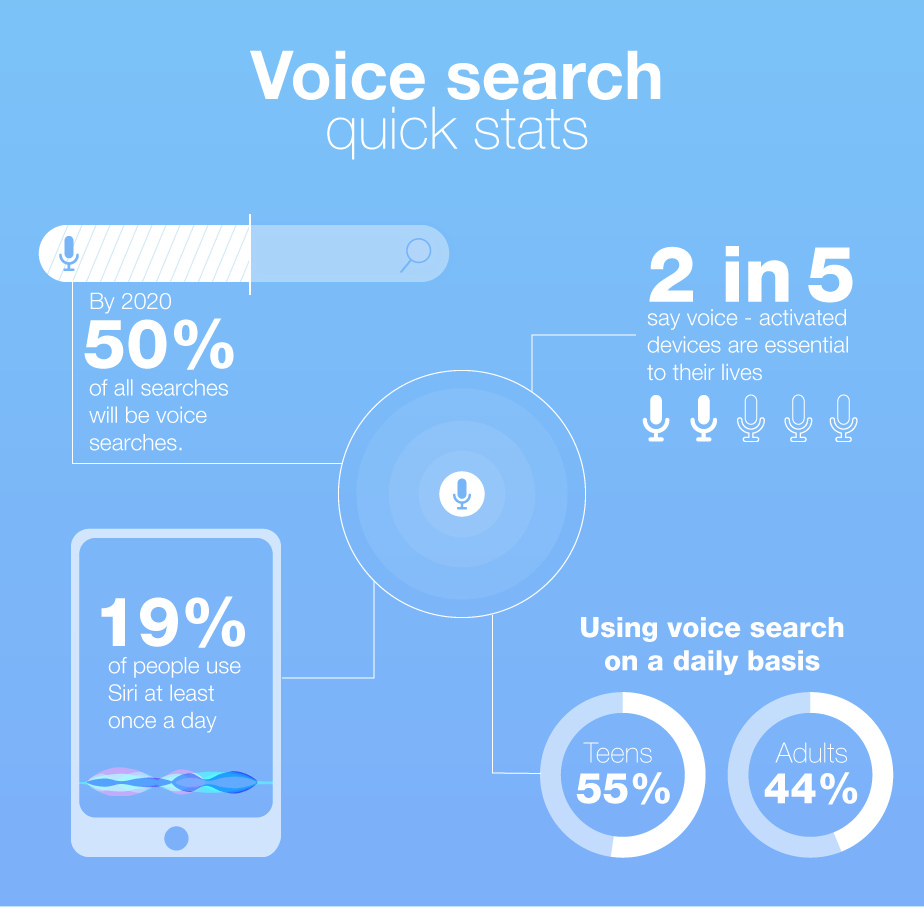
Simply, the increase in VS tech is going to increase the use of Voice Search. The newest version of Google’s assistant will be 10x faster than the current model and VS recognition is currently at 95 per cent accuracy.

VS is a rising SEO trend.

The key areas of Voice Search to be aware of

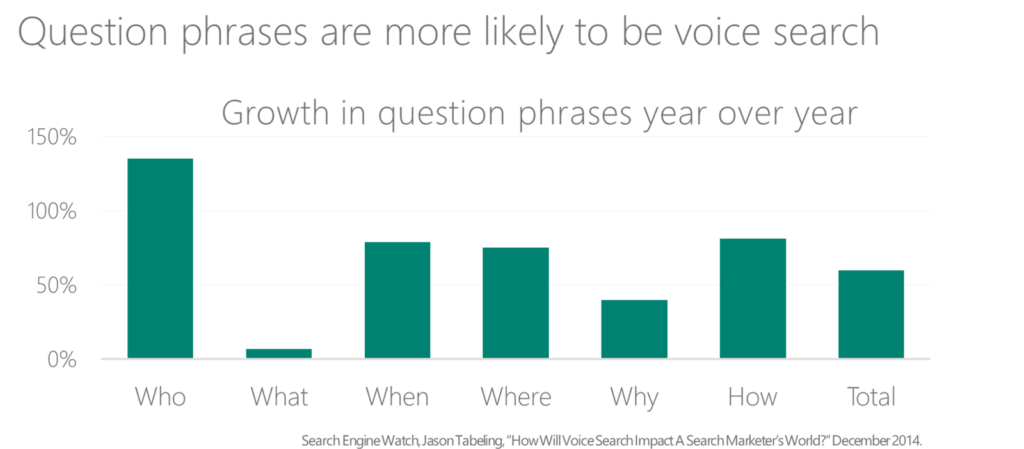
The user intent is different with VS. As opposed to finding information when doing a keyboard search (e.g. “how many Açaí bowls is too much to eat in one week”), people who use VS already plan to purchase the product. Instead, they’re looking to do something specific with the information given. Voice Search consists of action queries (e.g. “Where can I find an Açaí bowl near me”).

How to optimise your business for Voice Search

So, for websites, there’s a few key tips if you want to be on top. Your website needs to be fast, mobile-friendly and secure. There needs to be a strong emphasis on content readability aka websites should: have natural-sounding language, provide concise answers to questions and target long-tail key words. Stuffing your website with keywords isn’t going to cut it with Voice Search.

Source: bluecorona.com

Websites need to be providing answers in relation to common action queries from users. Finally, website information needs to be constantly updated (opening hours, address etc). You’d be surprised how often this doesn’t occur.

This is a really exciting topic and there is so much more to explore with Voice Search, but I’ve run out of space. If you want me to delve deeper, LMK in the comments and I might follow up with another post later on :O

Source: Giphy

Also, want to say a quick thank you to those following and engaging with my blog 🙂

Here’s a GIF of me werkin’ to create content for y’all. #youtherealmvp

PART 1: Search SEO

Types into Google…”Best Açaí bowl near me?”

Search Engine Optimisation (SEO), it’s bloody important for businesses hey?

So what is it? SEO involves increasing the quality and quantity of online traffic to a business’ website through organic search results.

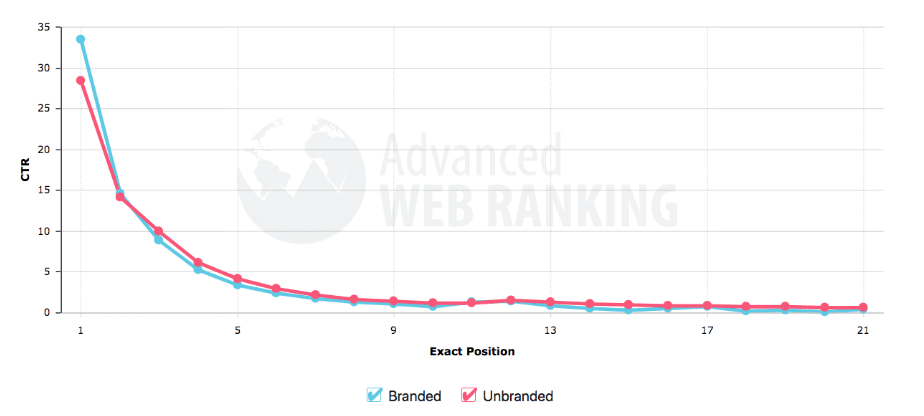
SEO is important for businesses because being as close to the top of a search result can seriously influence how often their website is being visited.

From: smartinsights.com

How do businesses improve their SEO? One way, is through On-page and Off-page optimisation.

On-page optimisation looks at the content that a business controls on their website. This can be boosted by increasing the density of key words on the page and occurrence of hyperlinks to other websites and platforms. Many more techniques can be found here.

Source: Giphy

Off-page optimisation refers to the measures taken outside the website to improve search rankings. A large number of inbound links from external and reputable websites is one way to do it.

As a young consumer, if I’m searching for a new product or service, I’m being pretty specific with my key words and I’m choosing one of the top results with good reviews. We’re talking over 4 stars.

So business’ really need to be thinking about the words consumers are likely to use when searching for their product and how they can increase traffic to their website.

You can find out more about SEO in digital marketing here. Let me know your thoughts below!

Tune into Part 2 soon where we look at SEO in Voice Search.

“Sooo… Podcast?”

Podcasts have become hugely popular with individuals, with more people tuning in AND creating them.

But what if businesses tapped into this digital marketing tool?

Source: Giphy

More consumers are wanting to know the ins and outs of the business they are trading with. What’s the product journey? What’s the business doing for the community? You get what I mean.

What better way to put a face  voice to a business than creating a podcast, right?

Here are three reasons why businesses should be thinking of making a podcast.

  1. They create a sense of familiarity and community between the business and the consumer (listener).

Running a podcast can be a fun and simple way to share insights to your business and create a following of listeners. As I said before, it puts a voice to the business that consumers are engaging with.

Source: gifrific.com

2. It can contribute to your revenue stream.   

Podcasts can be highly influential. If someone enjoys listening to your podcast, then they’re probably more likely to buy the product you promote.

3.It’s different.

In a globalised world, it’s getting more difficult to stick out as a business. Running a podcast is still unique enough that not a lot of businesses are doing it. It could be a great way to retain customers and build stronger relationships.

What do you think? Is it time for businesses to break out the microphone and head set and share their thoughts to the world?

Check out this list of cool Aussie business podcasts here.

“Fam, where we eating?”

Ask yourself this, “what is influencing where I am going to eat out?” Is it the reviews that you see online, advertisements, word-of-mouth or is it the Instagram-worthy shots of aesthetically looking food items you see on your timeline?

There is no doubt that social media and especially Instagram has created a huge influence on where customers are going to eat, but also what cafes and restaurants are serving up, ensuring that they stay on trend and marketable.

“Do it for the gram” which begun as an ironic saying, is now what restaurants literally rely on to ensure that their businesses stay on top. Popular Instagram food bloggers may find that they receive free meals or monetary compensation to take photos of the food they eat at restaurants and pop it on their feed.

Cafes and restaurants continue to follow trend, coming up with more extravagant and sometimes bizarre looking concoctions to attract attention and ensure that customers have a fresh new item to take a picture of.

An upload worthy photo from popular Instagram food blogger @veganfoodsmelbourne

So, is this a trend that we as a society can say that we’re happy with? Does it take away from the simple pleasure of enjoying a well-cooked meal with a loved one? Whether we’re happy with it or not, it’s a trend that has arrived with a bang and looks to be hanging around for a little while longer.


So next time you decide to head out to eat, think about what’s influencing you?

Design a site like this with WordPress.com
Get started