In its nature, digital marketing involves the collection, use and dissemination of personal information.
Data privacy concerns are on the rise. Cambridge Analytica harvesting the private information of Facebook users received huge backlash. The push for the re-launch of the My Health Record in Australia raised concerns about data breaches. This has meant that there is focused attention on regulators and law makers making decisions on big data, ad technology and direct marketing.
There are a few issues to look at here.
The first is the security threats to digital marketing. The My Health Record can be used as an example – where there was concern that a database filled with consumer’s personal information had the potential to be hacked. According to the PWC, in the past two years, 45% of Australian companies were attacked by online criminals.
Data being held by marketers is a treasure chest for hackers to pry into and take advantage of. As a result, digital marketers must be aware of the security threats to not only their consumers but themselves. Failure to do so could lead to legal and financial sanctions as well as terrible publicity.
The second issue is with organisations and marketers themselves. How lawful and trustworthy are they in attaining and then using personal data?
The Privacy Act 1988 was introduced to protect the privacy and personal information of individuals. In addition, it ensures that Australian Government agencies and organisations with an annual turnover rate of more than $3 million are regulated.
The Privacy Act makes it clear that marketers shouldn’t be collecting personal information unless it is absolutely necessary for business functions. There are also stricter rules on cross border disclosure of personal information – so businesses need to ensure that overseas recipients are not breaching the Australian Privacy Principles.
With smart products increasing in scale, marketers and organisations have greater ease in collecting data.
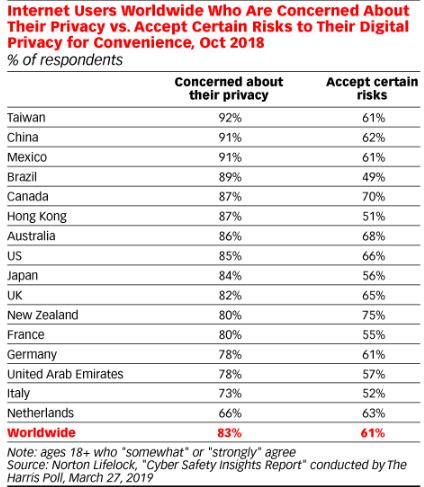
This table demonstrates that on average 83% of people worldwide have concerns about their privacy. However, there is still a large proportion that are accepting risks, whether that be not reading privacy policies before they sign up to an app. So does this mean people are just accepting the inevitable that we have entered a time period where it’s going to be impossible to completely protect your privacy?
What do you think about these issues of data privacy?


 THE AÇAÍ BOWL
True peace and privacy can only be achieved offline.
LikeLiked by 2 people
Great point! It would be very difficult to be offline these days though. A lot of things revolved around being online 😦
LikeLike
I think the convenience that people are getting from keeping everything online seems more lustrous than having to organise things offline. I value my privacy but keeping my personal information offline can become a hassle after knowing the convenience offered online.
LikeLike
I think you make a really good point and your reasoning definitely contributes to why people prefer to stay online and risk access to their privacy. I am similar and like to keep my work, photos etc on online databases so I can always access them where ever I am. In this case, I guess the pros outweigh the cons.
LikeLike
I have recently written a blog post (https://wrestlingwithmarketing.home.blog/2019/09/16/google-knows-everything-about-me/#comments) where I downloaded the data that google has collected on me. It was really eye-opening. It’s going to be interesting to see how this data collection continues and whether as you said, people become more aware of their data privacy or if they just accept the risk
LikeLike
Data privacy terms and conditions on certain platforms takes advantage of the fact that individuals do not read the fine print and that act in itself is an exploitation of their consumers in my opinion. I just dont understand why companies don’t make it clearer in regards to what theyre going to do with people’s data.
LikeLike